By Eimear Ashe, Collections Moves Project Manager, National Museum of Ireland
Introduction
Often called a ‘museum of a museum’, the Natural History Museum opened its doors on Merrion Street in 1857, as the dedicated exhibition space for the collections of the Royal Dublin Society (RDS). With the publication of the Dublin Science and Art Museum Act 1877, the Natural History Museum was then brought under the umbrella of what we now call the National Museum of Ireland.
Exhibitions
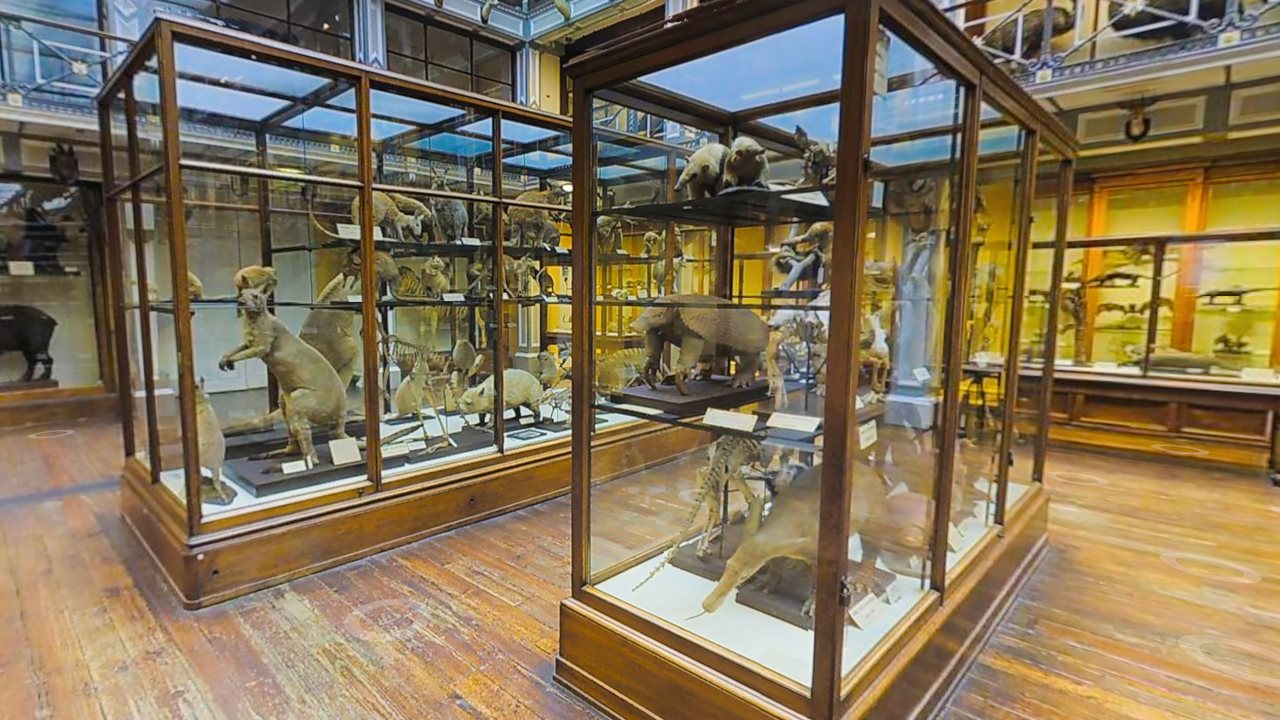
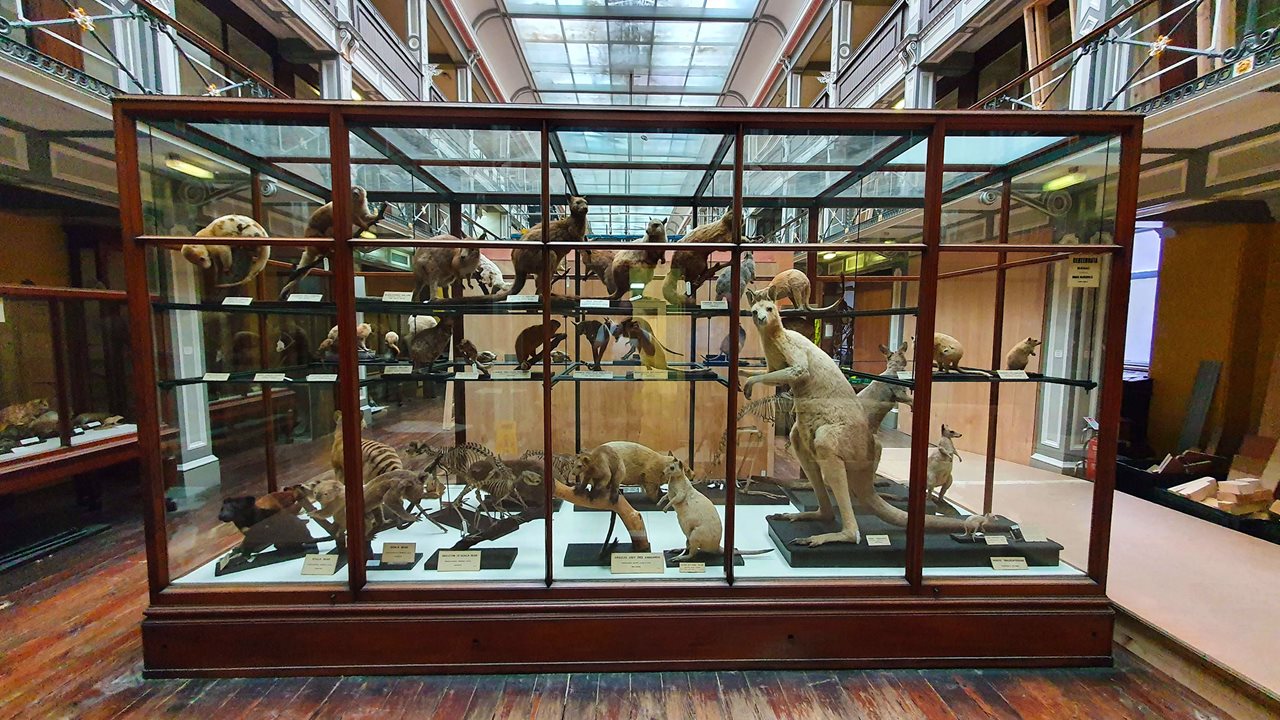
Before closing for renovation, the National Museum of Ireland, Merrion Street was a Victorian, cabinet-style museum, with high-density displays and a layout of collections which reflected zoological taxonomy. So, closely related animals were displayed together while distantly related animals were exhibited far away from each other. The exception is that Irish fauna was grouped together on the ground floor, while animals of the world were displayed across the first floor and two levels of balconies.
Display cases
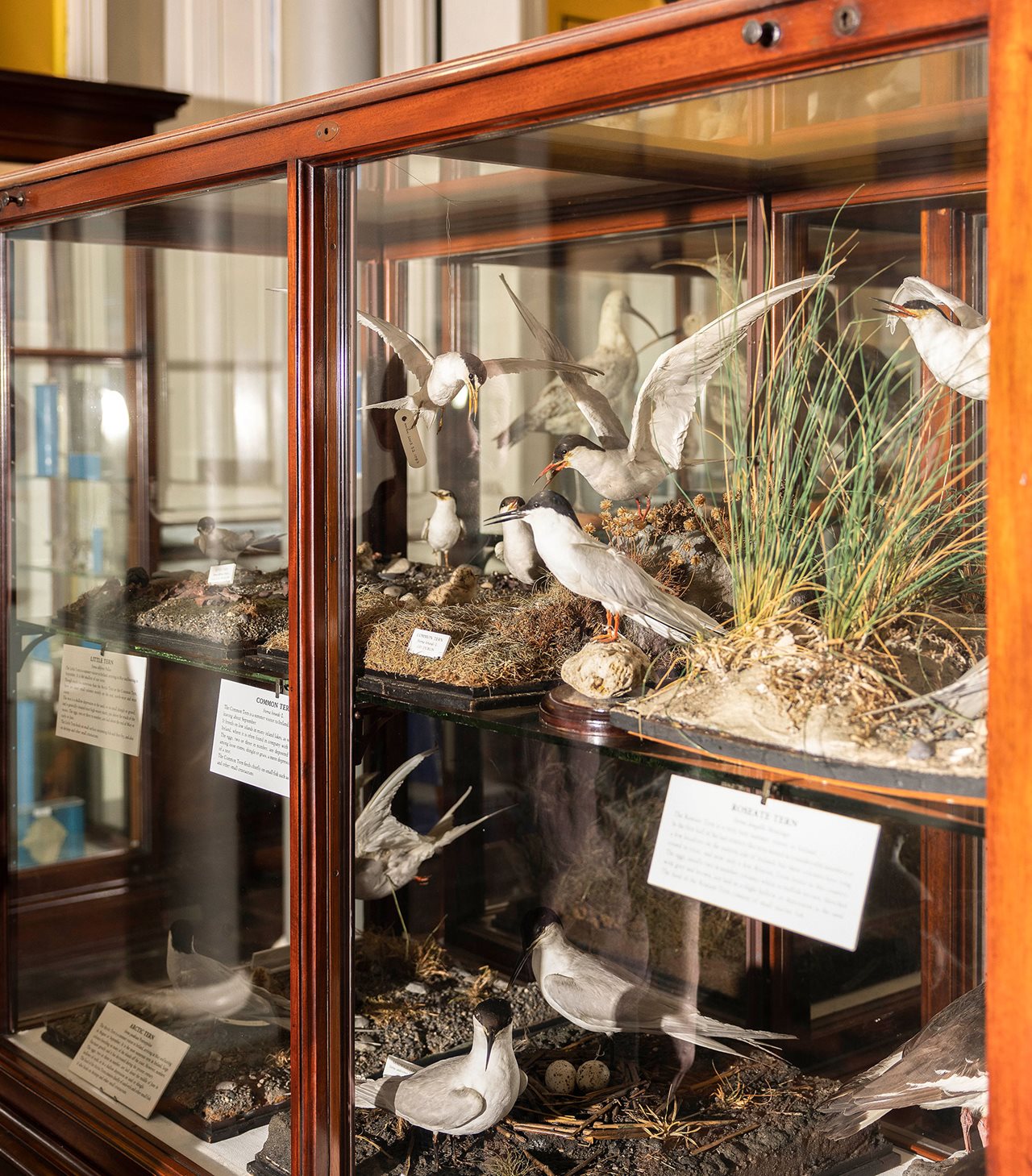
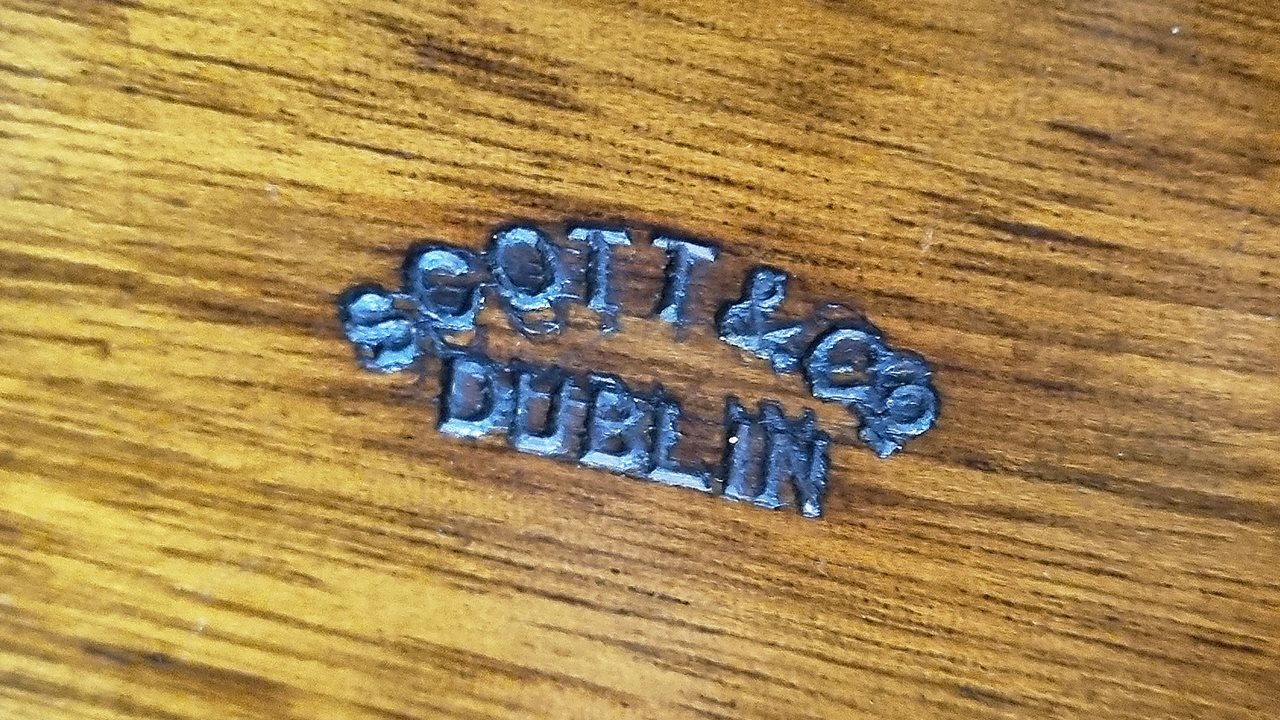
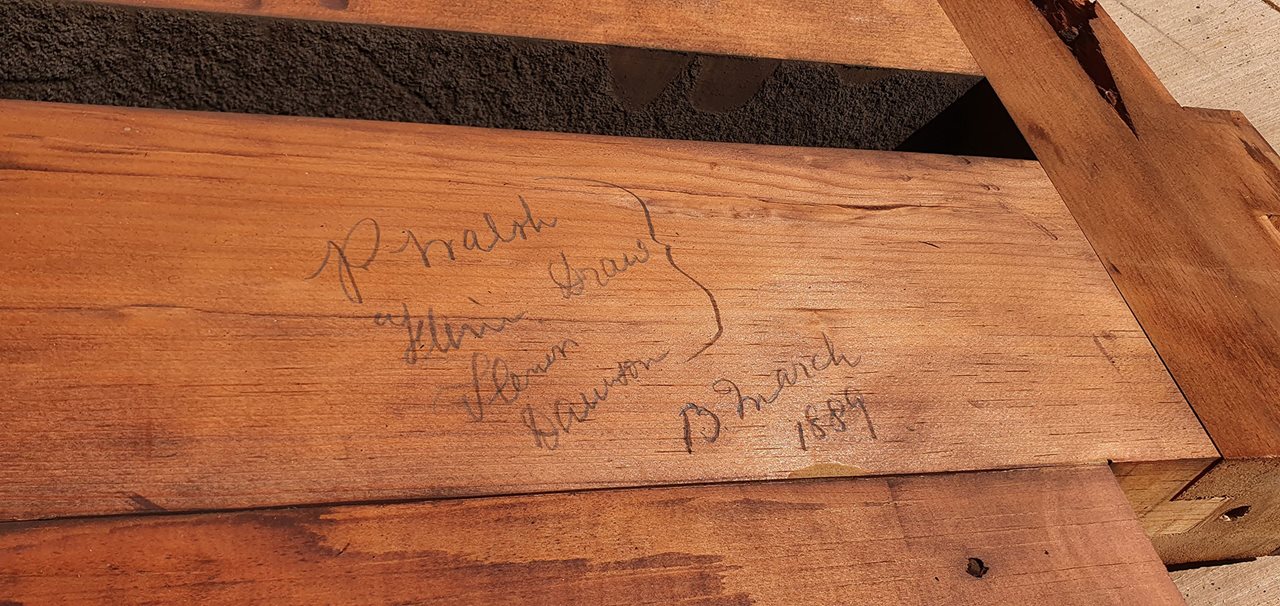
For the most part, our display cases are made from mahogany and plate glass – materials that are no longer available. The Museum has developed and evolved over hundreds of years, since its early days in 1733, when the RDS started exhibiting raw materials and new inventions. Over this period, display cases were occasionally made by state workshops, but the majority of cases were manufactured by private cabinet makers in the locality. Some vendor names which appear in RDS records are Scott & Co. (see image carousel), Thos. Jones, William Dawson, James Beckett, and H.W. McDowell. Upon dismantling one case we even discovered the surreptitious signatures of cabinet makers on the interior (see image carousel)!
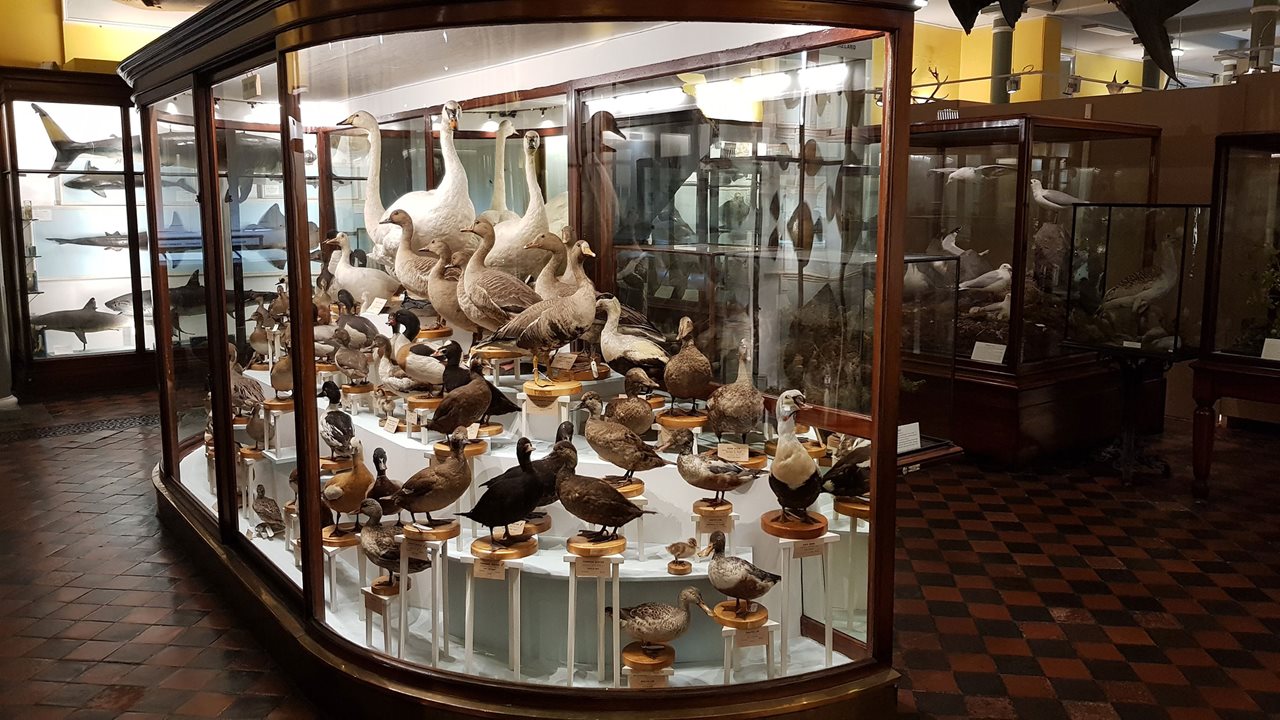
A recent survey found that the National Museum of Ireland, Merrion Street has over 350 display cases. These cover a very wide range of forms, such as cases built into wall recesses, freestanding cases to house large taxidermy, cases with a tabletop display area to show small objects, and many, many more. One case, informally known as the duck case, or the curved case, was not originally commissioned for use in the Museum. It is likely that it was a haberdasher’s window display adapted into a case, potentially acquired post-1916 after revolutionary activity on Dublin’s O’Connell Street.
Restoration project
As part of the Government of Ireland National Development Plan, the National Museum of Ireland is delighted to be working with the Department of Culture, Communication and Sport, and the Office of Public Works to deliver a restored, renewed and future-proofed National Museum of Ireland, Merrion Street. The Museum closed to the public in 2024 to enable a full decant of the exhibitions and to allow investigation works to take place onsite.
So, how do we plan to refurbish the National Museum of Ireland, Merrion Street? The building and its contents are considered by some to have been the subject of ‘benign neglect’ for generations (Monaghan, 2007), which has providentially endowed us with this much-loved ‘museum of a museum’. Our visitors often say that they want us to keep intact the sense of history in the Museum, and this is what we aim to do. To achieve this, part of our project is to retain the beloved historic display cases. We will work with skilled Irish craftspeople and conservators to preserve and improve the cases, enhancing their functionality for staff, and ensuring that the cases can provide an appropriate environment for the protection and display of our objects. By reusing these historic cases we also make a virtue of their embodied carbon, offering a more sustainable alternative to building new cases of steel and glass, which would have a much larger environmental footprint.
Current exhibition
Are you missing the National Museum of Ireland, Merrion Street? You can view a selection of our historic display cases and wonderful collections by visiting the Dead Zoo Lab at our Collins Barracks site. Admission is free.
Want to explore our collections online? Search for your favourite Natural History exhibits here to learn more.
References & Further Reading
Monaghan, N.T. (2007) ‘The Natural History Museum Dublin, past and future.’ Museum Ireland Vol. 17, 48-52.
Murphy, S. (2021) The First National Museum: Dublin’s Natural History Museum in the mid nineteenth century. Cork: Cork University Press.
National Museum of Ireland ‘Collections Online’ National Museum of Ireland Collections Online
National Museum of Ireland ‘A Dead Zoo Story’ A Dead Zoo Story | National Museum of Ireland
National Museum of Ireland '3D Virtual Vist' 3D Virtual Visit | Natural History | National Museum of Ireland
Thanks
Many thanks to the former Keeper of Natural History, Nigel Monaghan, for sharing his extensive unpublished research on this topic.