
By Foivi Nomikou
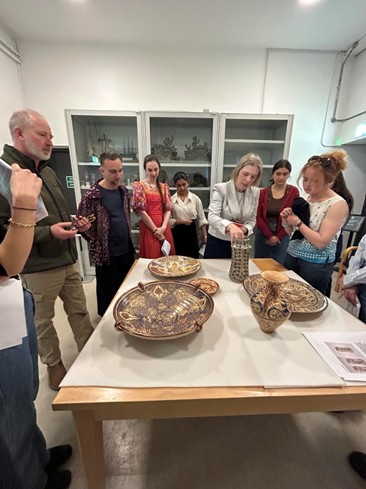
TCD Art History students with lecturer Anna McSweeney and ceramicist Mar
Campton examining Spanish Lustreware ceramics during a research visit to
National Museum of Ireland, Collins Barracks
The collection of Spanish lustreware from the 15th and 16th centuries, housed in the National Museum of Ireland’s Visible Storage galleries in Collins Barracks, presents unique specimens produced during the high point of ceramic production in al-Andalus, in the Nasrid kingdom of Granada, and in the Aragonese kingdom of Valencia. Our visit as fourth-year art history students to the museum in Spring 2025, initiated by our lecturer, Anna McSweeney, kicked off a fascinating project to study, catalogue, and bring to life the story of these ceramics.
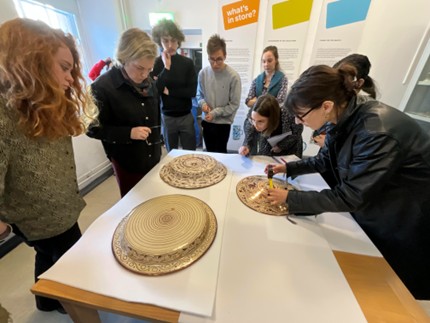
TCD Art History students examining Spanish Lustreware ceramics during a research visit to
National Museum of Ireland, Collins Barracks
The project and collaboration with the National Museum occurred within the context of our module dedicated to the arts of Islamic Spain. These ceramics, which had not been thoroughly studied before, offered an opportunity to immerse ourselves in the process of curating and research, allowing us to directly encounter and treat the objects themselves. This was firsthand fieldwork and research, something that we found invaluable. I still remember the amazement, awe, curiosity, but also caution we experienced when Curators Siobhán Doyle and Edith Andrees and Collections Assistant Sarah Nolan, kept bringing out all the ceramics we had seen only in photographs before.
.jpg?width=645&height=645)
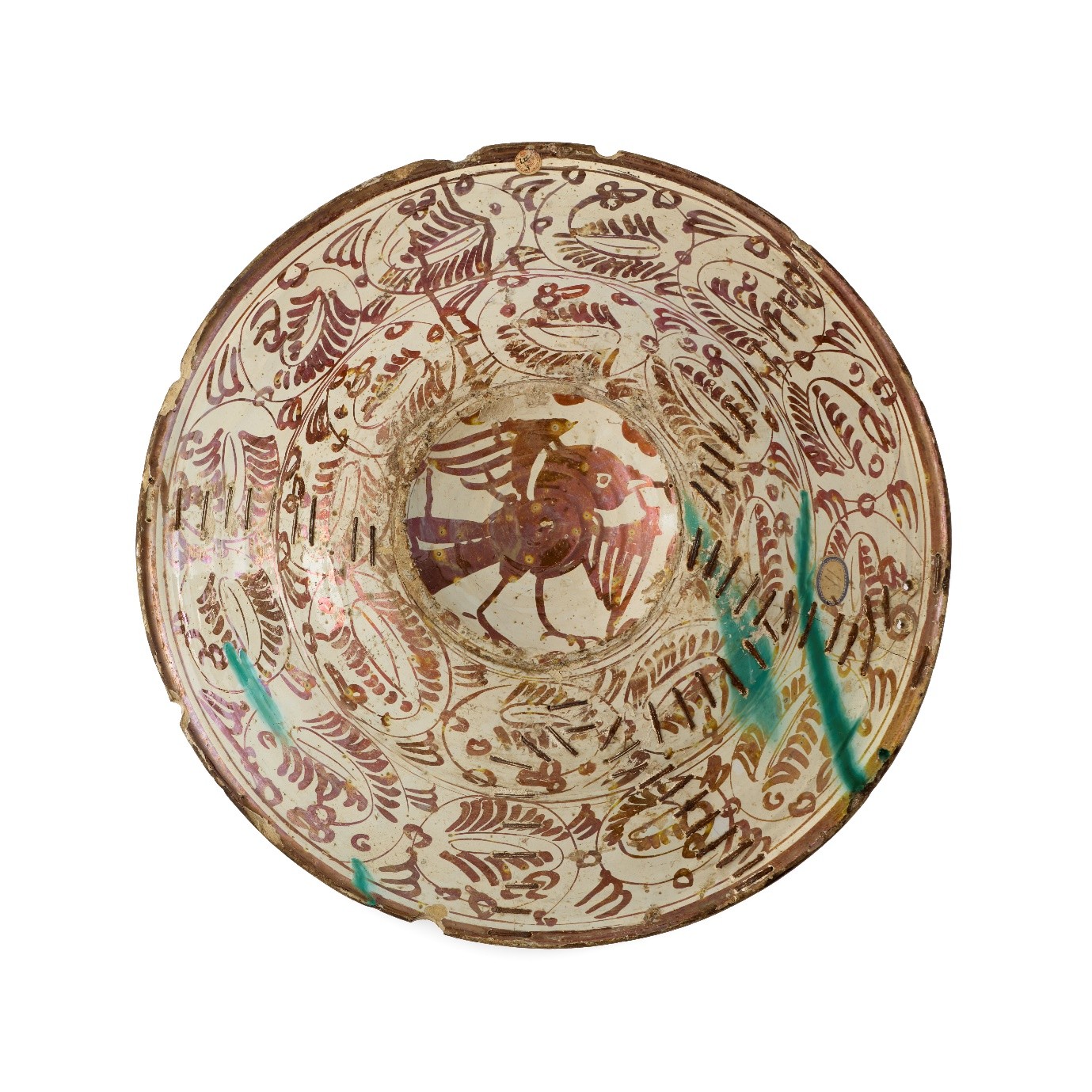
Lustreware plate depicting Lion of Aragon, c. late 15th century (DC:1885.327)
National Museum of Ireland
The first thing that struck us was the ceramics' size; most of them were larger than anticipated, indicating their primary use as tableware.
-National-Museum-of-Ireland.jpg?width=645&height=645)
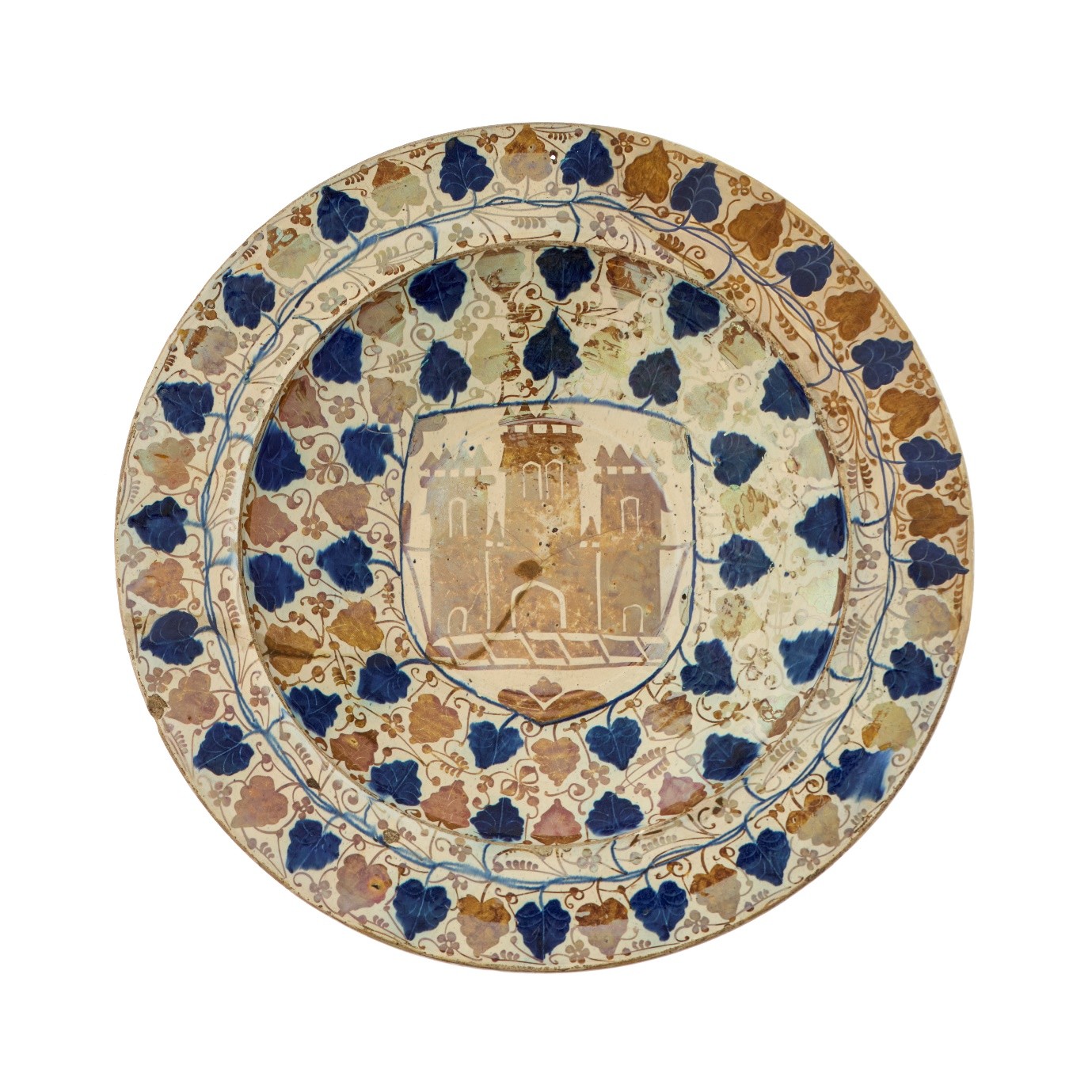
Lustreware plate, 15th century (DC:1885.326), National Museum of Ireland
The second element that we had not accounted for was their condition; whether they had smudges due to worn-off lustre or firing mistakes as for example, on this plate from c.15th century (DC:1885.327) where the green lines shine through or whether they had been repainted in parts as we saw on this dish evident in the leaves on the upper right part which are a dull colour brown instead of striking lustre. Furthermore, we understood the effect of the lustre technique, which is the metallic sheen that reflects when the ceramic or person moves, when viewed in comparison to each other or directly against sunlight.
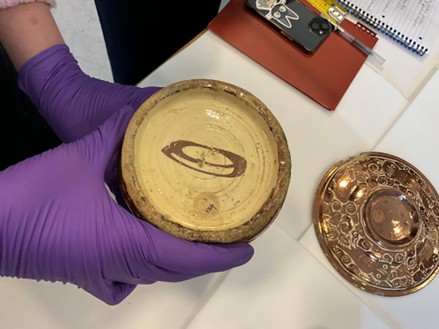
Reverse side of ceramic with historic label
Also, distinguishing reproductions from originals was insightful, as some bore historic labels or nail marks, revealing possible past acquisitions or display conditions. Thus, we came out learning more than we anticipated.
It took one visit to the museum's visible storage, accompanied by a careful examination of every ceramic, to make us understand the value of direct encounter with objects or artifacts.
Our project raised questions about the ceramics' function, design, and production techniques, as well as their journey to the National Museum of Ireland: How could we tell a longer history of lustreware ceramics informed by contemporary reproductions or museum displays? How important is it for art history students to engage directly with the material they study? Separated into groups, the class explored different themes that would ultimately be showcased in a final presentation.
A theme we gave special attention to was the ceramics' design; For example, we focused on the unique decorative results emerging from the combination of Islamic and European designs. In particular, we discovered that the active trading link between Manises, Valencia, Florence, all the way to France and Northern Europe reached a peak in the 15th century.
-National-Museum-of-Ireland.jpg?width=645&height=966)
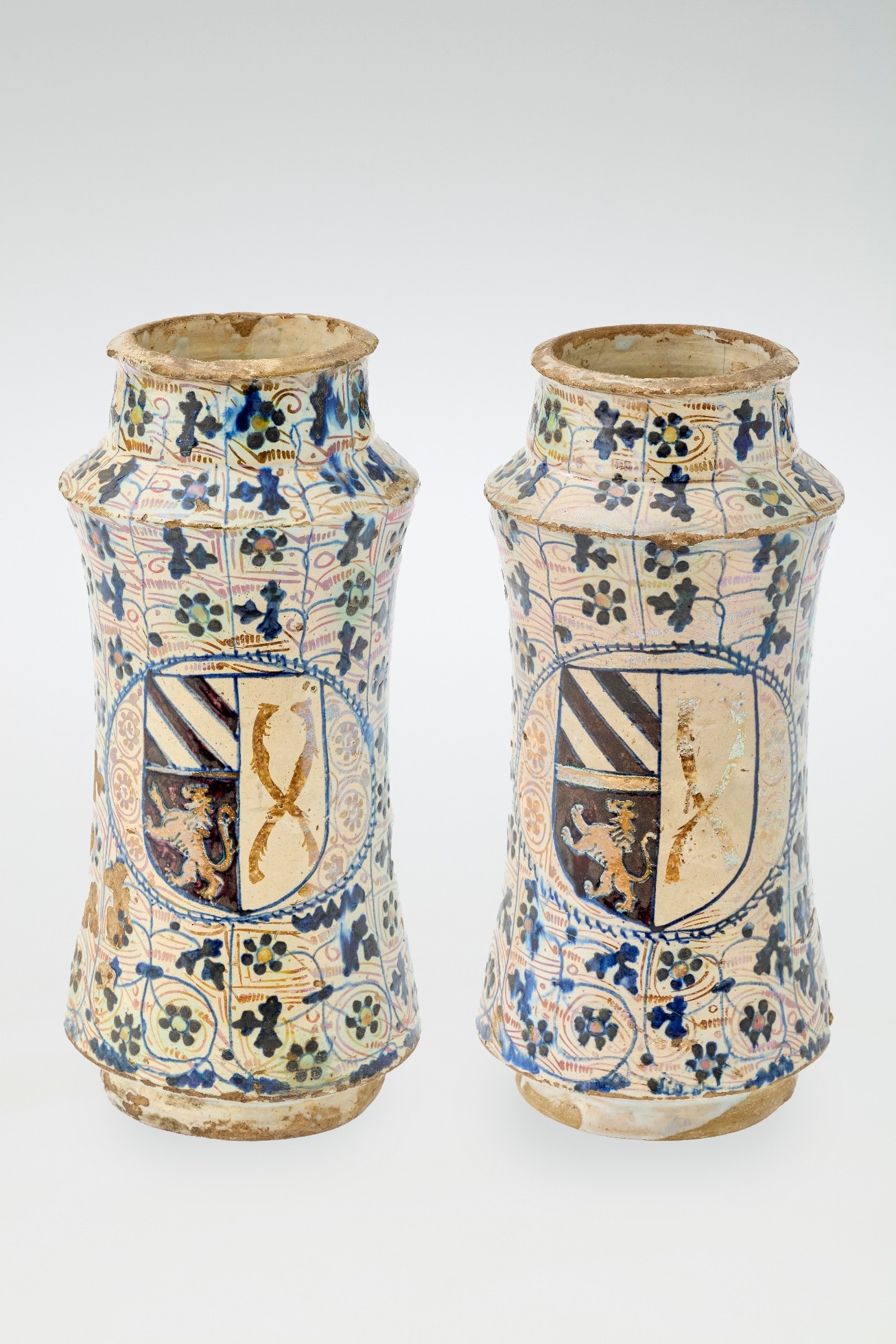
Pair of albarelli, late 15th century, (DC:1885.329-330) National Museum of Ireland
An intriguing find concerned a pair of albarelli. While albarelli were commonly used as domestic containers or medicine storage vessels, we concluded that these likely served display purposes, most likely due to their unglazed interior, something we would not have been able to uncover if we hadn't physically interacted with them.
Another factor that led us to this conclusion was the coat of arms standing prominently at the center, also hinting at their production for a European audience. Moreover, the bryony pattern (interwoven stems with alternating leaves of cobalt blue and brown luster) throughout the albarelli hints at their fifteenth-century dating and possible European origin.
-National-Museum-of-Ireland.jpg?width=645&height=645)
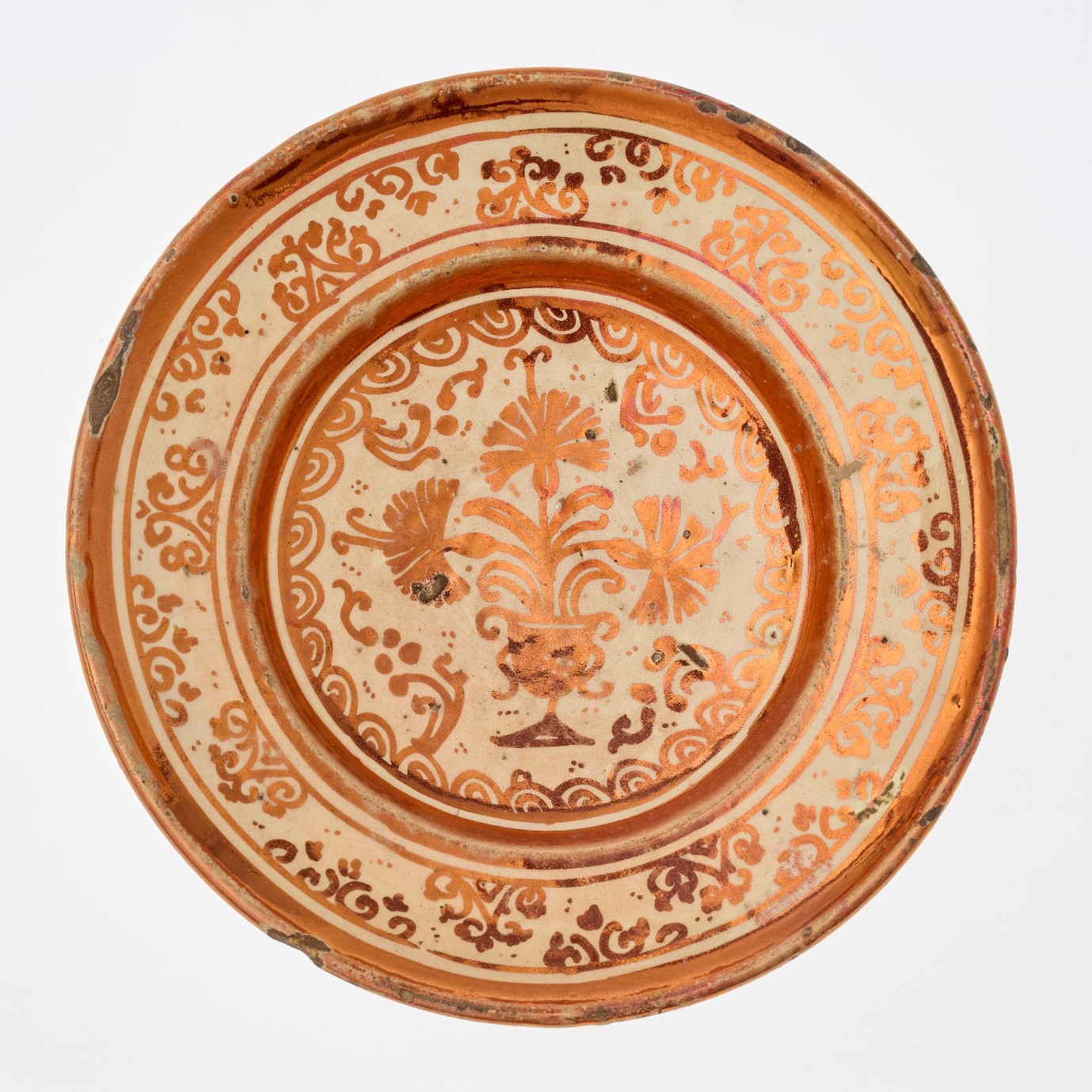
Hispano-Moresque lustreware plate, 19th century (DC:1912.54), National Museum of Ireland
Another fascinating discovery amongst the pieces of the Museum's collection, were the various reproductions dating from the 19th century distinguished from the contemporary objects due to their unnaturally shiny and uniform luster, typically copper-coloured, contrasting with the more golden or red hues of older pieces, something only really apparent when these are seen in real life. Despite their differences, both the earlier pieces and the reproductions should be examined within the broader tradition of Spanish lustreware, as they relate to each other in form and decoration.
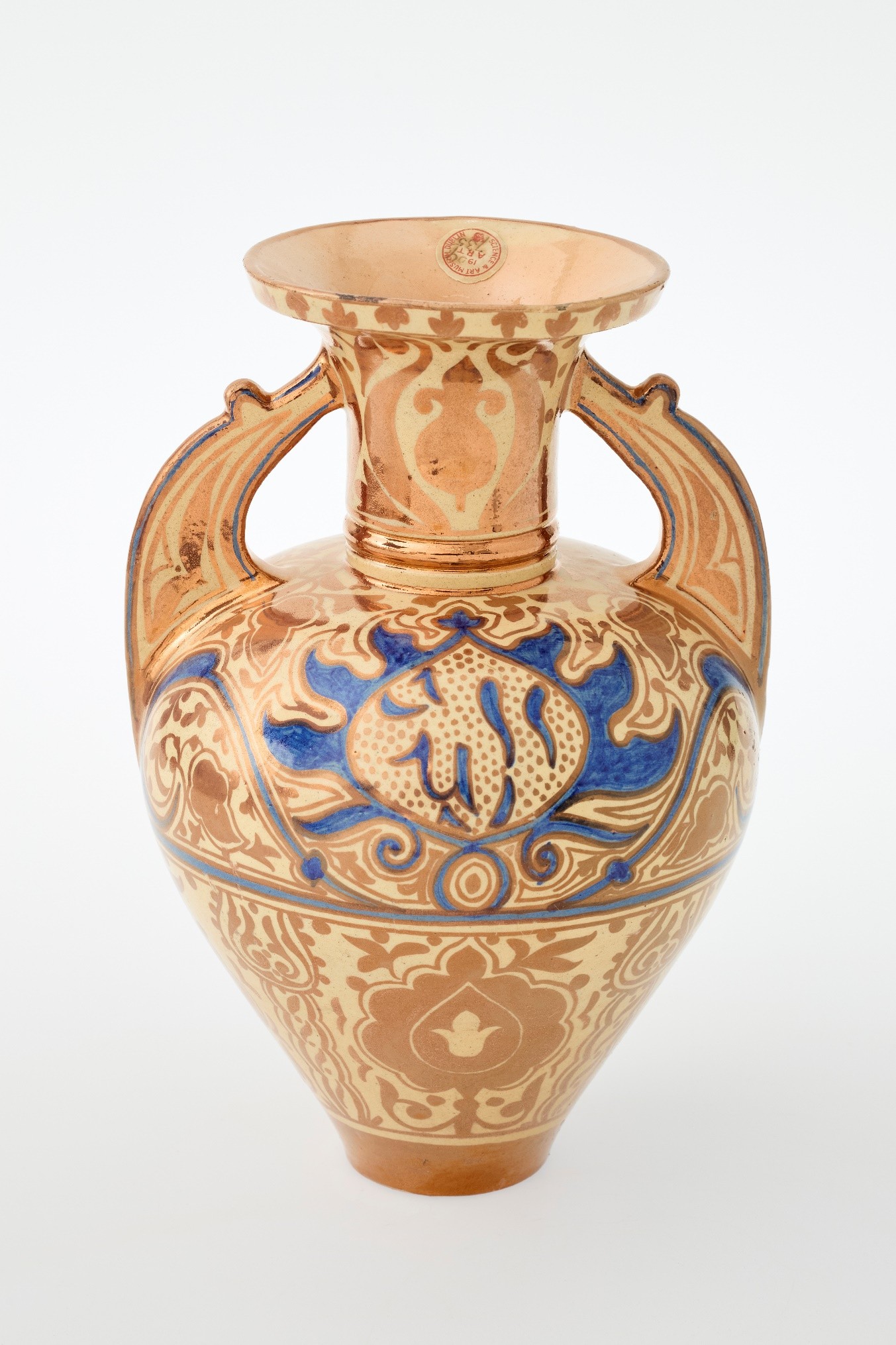
To place these reproductions into context, we studied the phenomenon of the rediscovery and revival of Spain's Islamic past, which developed in the 19th century, within a cultural climate of European interest in all things considered old or exotic. Spanish ceramics were amongst the objects experiencing this cultural revival, with entrepreneurs capitalizing on the widespread interest in Spain's past; as a result, potters and factories began making reproductions of these ceramics by incorporating the same techniques, forms, and decoration found in earlier pieces, as well as merging them with more recognizable 19th c. Alhambresque designs. The Alhambra Vases, in particular, inspired countless ceramic copies and miniatures as they were recognized as masterpieces of Spanish Islamic art. The National Museum owns one such example, a small lustered vase that reimagines the decoration and shape of its earlier predecessors.
-National-Museum-of-Ireland.jpg?width=645&height=967)
Vase, 19th century (DC:1909.735), National Museum of Ireland
It was most likely produced in Valencia in the second half of the 19th century, possibly the work of Jose Ros' workshop at La Ceramo (factory founder). In particular, the National Museum of Ireland has several pieces by the La Ceramco factory, one of the most famous producers of revival lustreware.
Returning to our museum visit and engagement with the ceramics, it is interesting to examine the Visible Storage space in which the objects were housed. At first, the visible storage puzzled us. On the one hand, the collection pieces lacked a central exhibition space. However, this is a problem that every museum faces, with hundreds of artifacts stored that cannot be viewed by the public, but also cannot be exhibited in the galleries due to a lack of space. On the other hand, this intermediate, halfway point between storage and display allowed us access to teaching and observing the collection, which would not have been possible if it were in actual storage.
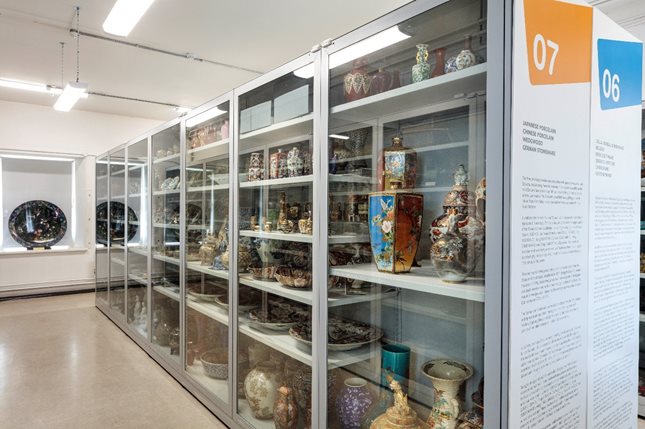
Visible Storage Galleries, National Museum of Ireland, Collins Barracks
Should museums have similar spaces that promote close looking and aid in teaching art history in more direct and immersive ways? Regardless of the answer, one thing is certain: learning through objects and visiting the museum's collection created a two-way conversation between us, the students, and the institution. Through this collaboration, we were able to conduct firsthand research on the ceramics, which added depth to our studies and, hopefully, aided in the museum situating its collection in context a little better.
In conclusion, direct encounter with objects is a valuable experience in an art museum, forming the basis for learning and engagement for all visitors. This active looking took another form when conducted in the way we experienced at the National Museum. It encouraged our cognitive reactions, distinct from simply knowing about an object and forcing us to actively learn from it.
This photo essay is based on a research paper presented by Foivi Nomikou at the Islamic Art in Ireland - Teaching, Curating, Researching conference at Trinity College Dublin in June 2025.