By Hannah Gallagher, Curator of Clothing, Textiles, Jewellery and Associated Accessories at the National Museum of Ireland
The earliest examples of rings in this style date to around 1700, and the design is often credited to Richard Joyce of Galway.
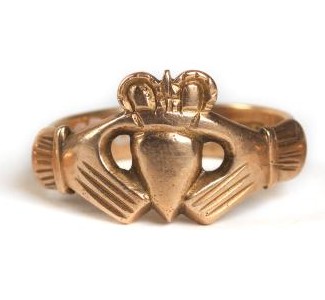
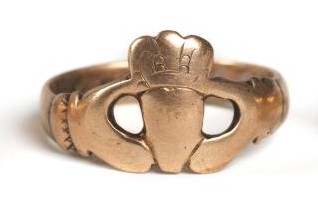
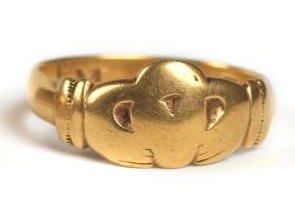
The design shows two hands clasping a crowned heart, which is thought to represent friendship, love and loyalty. It also resembles a fede ring, a ring symbolizing friendship, which dates back to the Roman Era. Claddagh rings were used as marriage and betrothal rings and are still popularly worn today.
There are traditions relating to the wearing of the ring, but the origin of these traditions is uncertain. The ring can be worn on the right hand, with the heart facing out, to show that the wearer has not yet found a love. If worn on the right hand with the heart facing in, the wearer has a romance.nIf worn on the left hand, it indicates that the wearer is married.
From the middle of the 19th century, the style of ring became associated with the village of the Claddagh, but was known to be worn in areas outside of this.
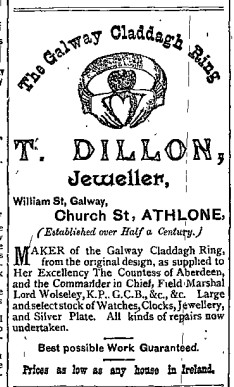
W. Dillon wrote in the Journal of the Galway Archeological and Historical Society in 1905, that the ring was worn ‘roughly from the Aran isles on the west, all through Connemara and Joyce’s Country and then eastwards and southwards for not more than 12 miles.’
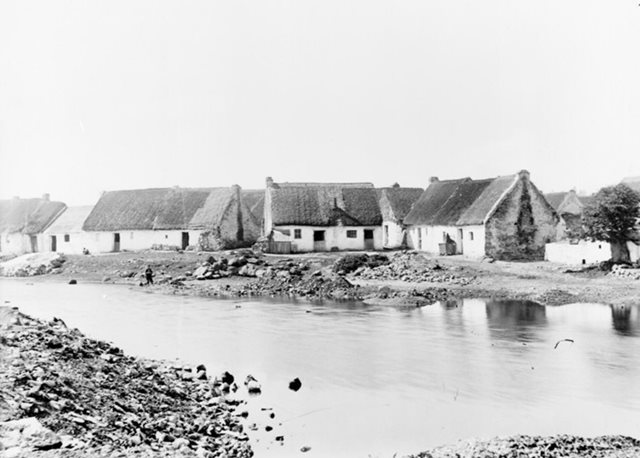
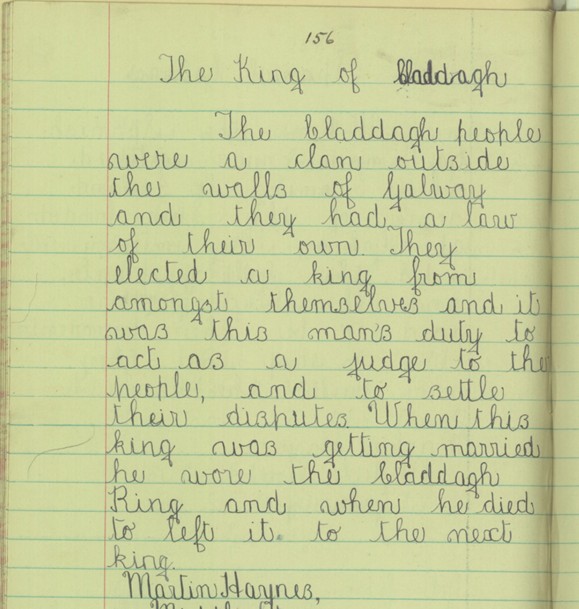
The Claddagh (known as An Cladach in Irish) is an Irish-speaking, fishing village, outside of the limits of Galway City. It was well known for its unique customs, which included the election of a King of the Claddagh on the twenty-third of June every year. In the 19th and early 20th centuries, the Claddagh was a unique settlement of mud walled, thatched cottages, with irregular streets and lanes. It was declared an ‘unhealthy area’ in 1927, and the traditional houses were demolished over the following years.
There are a number of stories that relate to the origins of the ring:
One story is that Richard Joyce of Galway, who lived in the 17th century, was captured and sold into slavery by Algerian Corsairs. He was sold to a goldsmith, who taught him his trade. Once William III became King of England, he was able to get British subjects in slavery in Algeria freed, and Joyce was one of these subjects. He is said to have made the ring while in captivity, and given it to his sweetheart on his return to Galway.
Another says that a ring resembling the Claddagh ring was dropped into the lap of Margaret Joyce in the 16th century. Margaret was married to the Mayor of Galway, and she is said to have used her fortune to build bridges throughout Connacht.
What way do you wear yours?
Bibliography
Delamer, I. (1996). The Claddagh Ring. Irish Arts Review Yearbook, 12, 181–187. http://www.jstor.org/stable/20492901
DILLON, W., & Dillon, T. (1905). The “Claddagh” Ring. Journal of the Galway Archaeological and Historical Society, 4(1), 11–16. http://www.jstor.org/stable/44969091
McMahon, S. (1997). The Story of the Claddagh Ring. Mercier Press
Mulveen, J. (1994). Galway Goldsmiths, Their Marks and Ware. Journal of the Galway Archaeological and Historical Society, 46, 43-64.
‘The King of the Claddagh’ , The Schools’ Collection, Volume 0084, Page 156